
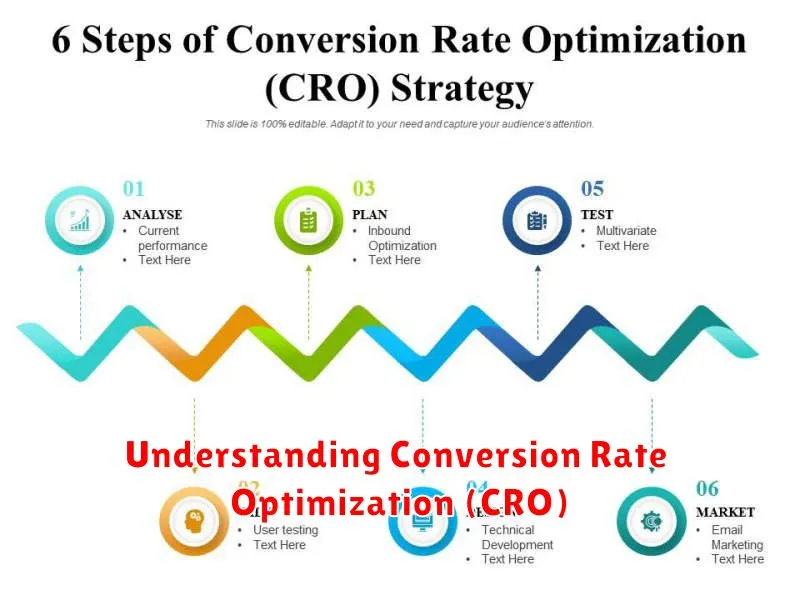
In the competitive digital landscape, Conversion Rate Optimization (CRO) is no longer a luxury, but a necessity. Understanding CRO is paramount to the success of any online venture, whether it’s an e-commerce store, a subscription service, or a lead generation website. This involves meticulously analyzing user behavior, identifying pain points in the conversion funnel, and implementing data-driven changes to improve the percentage of visitors who complete a desired action – a conversion. This could range from making a purchase, signing up for a newsletter, or filling out a contact form. Effective CRO strategies lead to increased revenue, improved return on investment (ROI), and a more profitable online presence.
This article delves into the core principles of Conversion Rate Optimization, providing a comprehensive guide to understanding its significance and practical application. We will explore the key elements of a successful CRO strategy, including A/B testing, user experience (UX) design, and data analysis. By the end of this article, you will have a solid understanding of how to leverage CRO to enhance your website’s performance, boost conversions, and ultimately achieve your business objectives. Learn how to transform casual visitors into valuable customers and maximize the potential of your online platform through strategic Conversion Rate Optimization.
What Is CRO and Why It Matters
Conversion Rate Optimization (CRO) is the systematic process of increasing the percentage of website visitors who complete a desired action. This action, known as a conversion, could be anything from making a purchase to signing up for a newsletter or downloading a resource.
CRO matters because it focuses on getting more value from your existing traffic. Rather than simply driving more visitors, CRO aims to make the most of the users already engaging with your site. This often leads to a higher return on investment (ROI) compared to solely focusing on attracting new users. By optimizing conversion rates, businesses can improve revenue, acquire more customers, and ultimately grow their business more effectively.
Identifying Bottlenecks in the Funnel
A crucial aspect of Conversion Rate Optimization (CRO) is identifying bottlenecks in your conversion funnel. A bottleneck is a point in the funnel where a disproportionately large number of users abandon the process. Locating and analyzing these friction points is key to improving conversion rates.
Bottlenecks can occur at any stage, from initial awareness to final purchase. Common examples include a complicated checkout process, unclear calls to action, or a poorly designed landing page. By pinpointing these areas of friction, you can implement targeted changes to streamline the user experience and encourage conversions.
Analyzing website analytics, heatmaps, and user session recordings can provide valuable insights into user behavior and help identify potential bottlenecks. Through careful observation and data analysis, you can uncover areas for improvement and optimize your funnel for better performance.
Heatmaps and Behavior Analytics Tools
Heatmaps visually represent user interaction on a webpage. They use color gradients to show where users click, move their mouse, and scroll. This data helps pinpoint areas of interest and potential usability issues.
Behavior analytics tools provide deeper insights into user behavior. These tools track metrics like session recordings, scroll depth, and time spent on page. Analyzing this data reveals how users navigate your site, identifying roadblocks and opportunities for improvement.
By combining heatmaps and behavior analytics, you gain a comprehensive understanding of user behavior. This knowledge is invaluable in identifying friction points, optimizing content placement, and ultimately improving conversion rates.
Creating Better Forms and CTAs
Forms and calls-to-action (CTAs) are crucial elements in converting website visitors into leads or customers. A well-designed form can significantly impact your conversion rates. Minimize the number of fields required to reduce friction. Request only essential information. Clearly label each field and provide helpful instructions or examples if needed.
CTA buttons should be visually prominent and use action-oriented language. Think “Get Started,” “Download Now,” or “Learn More.” The button color should contrast with the surrounding elements to draw attention. Ensure your CTAs are placed strategically throughout the page, especially near relevant content.
Testing different versions of your forms and CTAs is essential. A/B testing can help determine which variations perform best in terms of conversions. Experiment with button colors, text, form length, and placement to find the optimal combination.
Improving Page Speed for Conversion
Page speed is a critical factor in conversion rate optimization (CRO). A slow-loading website can lead to higher bounce rates and lost conversions. Users expect a seamless and fast online experience. Every second of delay can significantly impact your bottom line.
Optimizing page speed involves various techniques, including minimizing HTTP requests, compressing images, leveraging browser caching, and optimizing your website’s code. By addressing these technical aspects, you can dramatically improve the user experience and increase the likelihood of conversions.
Key benefits of improved page speed include enhanced user satisfaction, increased conversion rates, improved search engine rankings, and reduced bounce rate.
CRO Testing Techniques (A/B, Multivariate)
CRO relies heavily on testing to validate hypotheses and make data-driven decisions. Two primary methods are A/B testing and multivariate testing.
A/B testing compares two versions of a webpage (A – original, B – variation) with a single element changed, like a call-to-action button or headline. The version that performs better regarding conversions becomes the new standard.
Multivariate testing (MVT) is more complex. It tests multiple variations of several elements simultaneously. This helps pinpoint which combination of changes yields the highest conversion rate. While MVT provides more granular insights, it requires significantly more traffic to reach statistical significance.
Using Customer Feedback for CRO
Customer feedback plays a vital role in successful Conversion Rate Optimization (CRO). Understanding why visitors aren’t converting is crucial. Directly asking your customers provides invaluable insights.
Methods for gathering feedback include surveys, polls, on-site feedback widgets, and user testing. Analyze this data to identify pain points in the user journey.
Common issues uncovered through feedback might include a confusing checkout process, unclear website navigation, or lack of trust signals. Addressing these issues directly improves the user experience and, consequently, conversion rates.
Real CRO Case Studies
Examining real-world CRO case studies provides valuable insights into the practical application of optimization strategies. These studies showcase how targeted changes to websites and marketing materials can lead to significant improvements in conversion rates.
For example, one case study might analyze how a company redesigned their landing page, leading to a 20% increase in form submissions. Another could detail how A/B testing different call-to-action buttons resulted in a 15% lift in click-through rates.
By studying these examples, you can gain a deeper understanding of the impact of CRO and learn how to apply similar techniques to your own projects. Analyzing case studies helps to illustrate the relationship between specific changes and their resulting impact on key metrics.
