
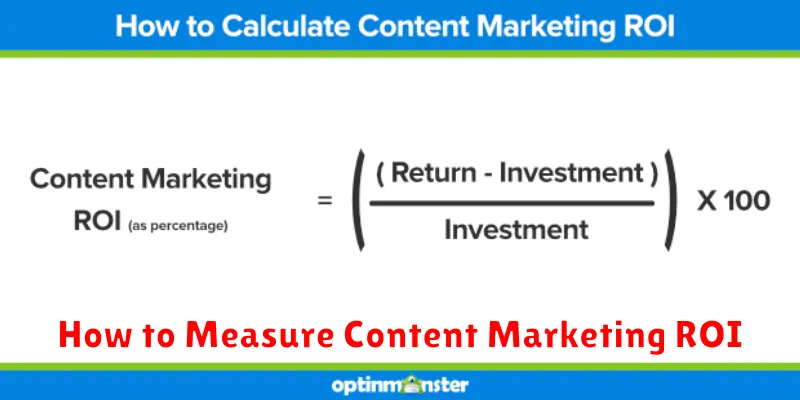
Measuring the Return on Investment (ROI) of your content marketing efforts can be a complex undertaking. Many marketers struggle to connect the dots between engaging content and tangible business results. This article will provide a comprehensive guide on how to measure content marketing ROI, offering practical strategies and actionable insights to demonstrate the value of your content. Learn how to track key performance indicators (KPIs), analyze data effectively, and ultimately prove the impact of your content marketing investment on your bottom line.
From lead generation and sales conversions to brand awareness and customer loyalty, understanding the ROI of content marketing is crucial for optimizing your strategy and securing continued investment. This article will equip you with the knowledge and tools necessary to effectively measure your content’s performance and demonstrate its contribution to business growth. By implementing the techniques outlined here, you can confidently present the value of your content marketing program and make data-driven decisions to maximize its effectiveness.
Setting KPIs for Your Content
Key Performance Indicators (KPIs) are crucial for measuring the effectiveness of your content marketing strategy. Choosing the right KPIs, aligned with your overall business goals, is the first step.
Consider KPIs related to brand awareness such as social media reach and engagement (likes, shares, comments). For lead generation, track form submissions, email sign-ups, and content downloads.
Sales-focused KPIs might include website conversions, product demos booked, and ultimately, revenue generated. Customer retention KPIs can include customer satisfaction scores, repeat purchase rates, and customer lifetime value improvements.
Attribution Models Explained
Understanding how to attribute conversions to your content marketing efforts is crucial for measuring ROI. Attribution models assign credit for conversions to different touchpoints in a customer’s journey. Selecting the right model depends on your business and marketing strategy.
Several common attribution models exist:
- Last Click: Gives 100% of the credit to the last touchpoint before conversion.
- First Click: Gives 100% of the credit to the first touchpoint.
- Linear: Distributes credit evenly across all touchpoints.
- Time Decay: Gives more credit to touchpoints closer to the conversion.
- Position Based: Assigns a larger percentage of credit to the first and last touchpoints.
Choosing the appropriate model will provide a more accurate view of your content’s effectiveness and inform future content strategy decisions.
Using Google Analytics for Tracking
Google Analytics is a powerful free tool that provides valuable insights into website traffic and content performance. It’s crucial for measuring content marketing ROI.
By setting up goals and tracking key metrics, you can understand how your content contributes to business objectives. Track metrics like bounce rate, time on page, and conversion rates to measure content effectiveness.
Use campaign tracking to attribute traffic and conversions to specific content campaigns. This helps determine which campaigns are driving the most valuable results.
Time-on-Page and Scroll Depth
Time-on-page and scroll depth are engagement metrics that provide insights into how users interact with your content. Time-on-page measures the duration a user spends on a specific page. A longer time-on-page often suggests higher engagement and interest in the content.
Scroll depth tracks how far down a page a user scrolls. Analyzing scroll depth helps determine if users are consuming the majority of your content or dropping off before reaching key information.
While these metrics offer valuable information, consider them in context with other data. A high time-on-page combined with low scroll depth might indicate a user struggling to find information. Conversely, high scroll depth paired with short time-on-page may suggest users quickly scanned the content.
Turning Insights into Strategy
Analyzing data is only the first step. The crucial next step is transforming these insights into actionable strategies. This involves identifying key trends and patterns revealed by your data analysis.
For example, if data reveals a particular content format (e.g., video) is generating significantly more leads than blog posts, your strategy should prioritize creating more video content. Similarly, understanding which channels are most effective for distribution allows you to optimize your content promotion efforts.
This data-driven approach ensures your content marketing efforts are aligned with your business goals and maximizes your return on investment.
