
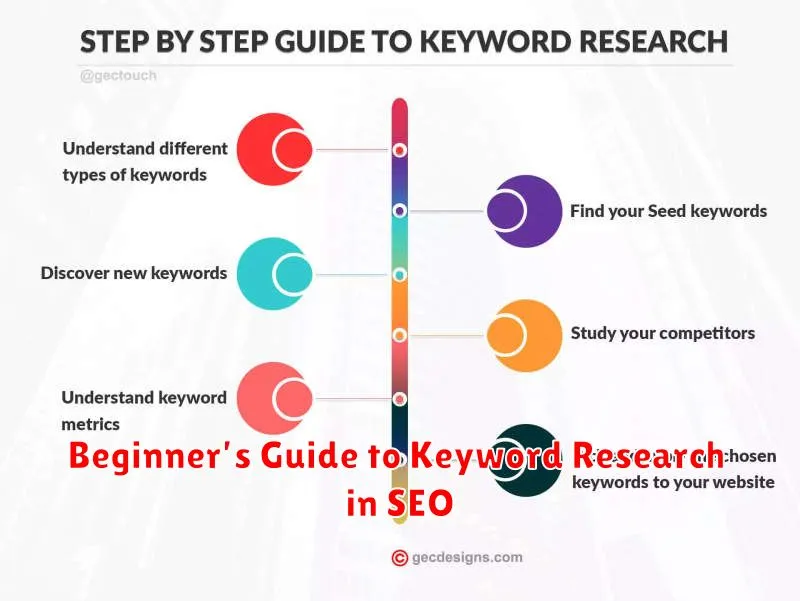
Keyword research is the foundation of any successful SEO strategy. Understanding how to identify the right keywords, the terms people actually use when searching online, is crucial for driving organic traffic to your website. This Beginner’s Guide to Keyword Research in SEO will equip you with the knowledge and tools necessary to conduct effective keyword research, enabling you to optimize your content and improve your search engine rankings. From understanding the basics of keyword research to utilizing advanced research techniques, this guide will cover everything you need to know to get started.
Whether you’re completely new to SEO or just looking to refine your keyword research process, this guide will provide valuable insights. You’ll learn how to identify relevant keywords, analyze search volume, and assess keyword difficulty. By mastering these essential elements of keyword research, you’ll be well on your way to attracting more qualified leads and growing your online presence. This guide provides a step-by-step approach to keyword research for SEO, empowering you to make data-driven decisions and achieve sustainable search engine optimization success.
Why Keyword Research Is Crucial
Keyword research is the foundation of any successful SEO strategy. It provides crucial insights into what your target audience is searching for online. Understanding these search terms allows you to tailor your content to meet their needs and ultimately, rank higher in search engine results pages (SERPs).
By identifying the right keywords, you can attract more qualified traffic to your website. This means reaching users who are actively looking for the products, services, or information you offer. Without keyword research, you risk creating content that no one is searching for, rendering your SEO efforts ineffective.
Effective keyword research also informs your content strategy. It helps you understand which topics to cover, how to structure your content, and what language to use to resonate with your target audience. This leads to increased engagement, lower bounce rates, and improved conversion rates.
Short-Tail vs Long-Tail Keywords
Understanding the difference between short-tail and long-tail keywords is crucial for effective keyword research. Short-tail keywords are generally shorter, consisting of one to three words. They have high search volume, but also high competition. Think “shoes” or “coffee”.
Long-tail keywords, on the other hand, are longer phrases, typically containing three or more words. They have lower search volume, but they are more specific and less competitive. Examples include “best Italian coffee beans” or “women’s running shoes size 8”.
Targeting a mix of both short-tail and long-tail keywords is recommended for a comprehensive SEO strategy.
Using Tools Like Ahrefs and Ubersuggest

While free keyword research tools offer a starting point, premium tools like Ahrefs and Ubersuggest provide significantly more in-depth data.
These tools offer features such as:
- Competitor analysis: See which keywords your competitors rank for.
- Backlink analysis: Understand the backlink profile of competing pages.
- Keyword difficulty: Estimate the difficulty of ranking for a specific keyword.
- Search volume: Get accurate monthly search volume data.
- Keyword suggestions: Discover related keywords you might not have considered.
Using these tools allows for more informed decisions when selecting target keywords, ultimately leading to a more effective SEO strategy.
Analyzing Keyword Difficulty and Volume
After brainstorming potential keywords, the next crucial step is analyzing their difficulty and search volume. Keyword difficulty estimates how challenging it is to rank for a specific keyword, considering factors like competitor authority and backlink profiles. A higher difficulty score indicates more competition.
Keyword volume represents the average number of monthly searches for a particular keyword. Higher volume suggests greater potential traffic, but often comes with increased competition. Finding the right balance between volume and difficulty is key to effective keyword research.
Use keyword research tools to obtain both metrics. Prioritize keywords with a reasonable search volume and manageable difficulty, especially when starting. Targeting low-competition keywords can yield quicker results and build momentum for tackling more competitive terms later.
Mapping Keywords to Content
After researching and selecting your target keywords, the next crucial step is mapping them to your content. This involves strategically assigning specific keywords to individual pages or pieces of content on your website.
Effective keyword mapping ensures that each page has a distinct focus, preventing keyword cannibalization (where multiple pages compete for the same keyword). This clarity helps search engines understand the topic of each page, improving your chances of ranking higher.
Consider the search intent behind each keyword. Informational keywords should lead to informative content, while transactional keywords should lead to product pages or purchase options. A well-structured spreadsheet can be a valuable tool for organizing your keyword map.
Avoiding Keyword Stuffing
Keyword stuffing is the practice of overusing keywords on a webpage in an attempt to manipulate search engine rankings. This practice is considered black hat SEO and can result in penalties from search engines.
Instead of stuffing keywords, focus on creating high-quality content that naturally incorporates relevant keywords. Think about how a user would search for your content and use those keywords organically within the text.
Prioritize readability and a positive user experience. Search engines prioritize content that is valuable and engaging for users. Keyword stuffing makes content difficult to read and can deter users from engaging with your website.
Tracking Keyword Rankings Over Time
Tracking keyword rankings is crucial for measuring the effectiveness of your SEO efforts. It provides insights into how well your website is performing for targeted keywords in search engine results pages (SERPs).
By consistently monitoring your rankings, you can identify which optimization strategies are working and which need adjustments. Regular tracking helps you understand the impact of content updates, technical SEO improvements, and link building activities on your keyword visibility.
Several tools are available for tracking keyword rankings. Some popular options include SEMrush, Ahrefs, and Google Search Console. These tools allow you to monitor your rankings across different search engines and track your progress over time.
